
Earthrise by Amanda Gorman
Thursday, January 21, 2021


Sunday, February 2, 2014
CLIMATE CHANGE - UNIVERSITY OF EXETER - Week 2
This is the reflection for the second week (January 20-26) since I am a bit behind (ha!). The second weeks lesson was really fascinating because it was covering primarily paleo-climate information. Prior to week 2 readings I had only the haziest notion of paleo-climate, so it was really informative.
I understand that of necessity the paleo-climate models they provided us were simplified (nothing about ocean currents for example in discussing mechanisms of climate), but despite being simplified they were quite powerful in providing explanations for the major long term changes in earth's climate.
First important discovery: our sun, Sol, puts forth substantially more energy today than it did 4.4 Billion years ago when the solar system and Earth was formed. Now before someone goes "ah ha! that's what's driving global warming today" let's quickly put that to rest. We are talking a slow, gradual warming for the entire 4.4 Billion year period - which covers both much warmer and much colder geological periods, and has little to do with the dramatic increase in temperatures observed in just the past 150 years since the start of the industrial age.
So 4.2 Billion years ago (once the surface of the planet settled down enough to result in rock evidence we can still find today), the sun was substantially weaker, and earth received substantially less solar radiation. The estimate is 20 to 30 percent less energy output 4.2 Billion years ago (https://www.sciencenews.org/article/faint-young-sun). This creates a bit of a puzzle: if we were to suddenly lose 20 to 30 percent of the sun's energy today, our world would plunge into a bitter freeze. The earth's surface would be so cold that there would be no liquid water left. But geologists and paleo-biologists can demonstrate to us in the form of fossils, and evidence of rain and water weathering that there was abundant liquid water on the surface of the earth 4.2 Billion years ago. So how come the earth was warm enough for liquid oceans, rain, streams and lakes even though there was less radiation from the sun. The most accepted hypothesis is that the earth's atmosphere was much denser and had much higher levels of carbon dioxide, methane, and combinations of nitrogen and oxygen that facilitated heat absorption. One source of these greenhouse gases would have been volcanoes. This is still an area of research and discussion to find the precise mechanisms for the warming.
A new puzzle arises when one asks the question, well if the earth were as least as warm as it is today, with less sunlight and more greenhouse gases, why didn't the earth get consistently hotter over time? The key to that is in chemical and geological processes that remove carbon dioxide from the air and lock it up in rocks in the earth's surface. Particles of carbon dioxide are absorbed by water vapor and create rain, a lightly acidic rain (carbonic acid rain) that over time weathers (chemically wears down) the rocks of the earth's surface. Rain run-off in streams and rivers carries that rock and carbon bearing water into the oceans where the carbon and other minerals from the rock are used by tiny living creatures in the oceans to build their bodies and their shells. When they die, their remains filter to the bottom of the ocean and provide the sediments that become sedimentary rocks. Constant weathering and the growth of living species removes carbon from the atmosphere over the billions of years that the sun grew brighter.
About 2.2 Billion years ago a new puzzle emerges. For the first 2 billion years the earth's climate experienced swings from warmer to cooler, with the shrinking and growing of the earth's icy poles bearing witness to those swings. But at about 2.2 Billion years ago the geological evidence strongly supports the idea that the whole surface of the earth froze over, creating what is called "snowball earth". There are a variety of things that might have caused a cooling cycle, and physicists have determined that if as much as two-thirds of the earth's surface became covered with ice and snow, then the dramatically increased albedo (reflection back into space of sunlight) would reach a tipping point and there would be nothing to stop the earth from freezing entirely, which is apparently exactly what happened. The true puzzle becomes, how did the earth emerge from that frozen state to return to millions of years of much warmer climates? The key seems to be in the continuation of volcanic action throwing more greenhouse gasses into the atmosphere, but with all surface water frozen there was no rain to wash the carbon dioxide out of the air, create carbonic acid rain, and engage in rock weathering that would sequester the carbon in the earth's surface. So the concentrations of greenhouse gases increased, and increased and increased until the air was warm enough to begin melting the ice ball.
To me the most significant aspect of all this information is that the basic mechanism of climate - sunlight and greenhouse gases were the same 4.2 billion years ago as they are today, the only difference is that today we industrial humans are inputting significant additional carbon, methane, etc. into the atmosphere with our economic activity. We are taking carbon that was sequestered in the earth's crust for billions of years, hauling it out, burning it and returning it to the atmosphere. So that in 2013 the Mauna Loa monitoring station measured 400 ppm of atmospheric carbon dioxide, a level not seen on earth for the past 2 million years.
Saturday, January 18, 2014
CLIMATE CHANGE - UNIVERSITY OF EXETER - Week 1
Even though I've been teaching about climate change for 15 years, there's still a lot of the science I don't fully understand, and I'm also always looking for ideas on how best to communicate complicated ideas about the environment to my undergraduate students, and how to engage them more fully in learning. So I happened across this link to Future Learn an on-line learning consortium of British universities, and in particular to an undergraduate oriented course on climate change. It's eight weeks long, free, and so far seems quite engaging. This is not my first on-line learning experience (I also teach mostly on-line classes) but it is my first experience with a MOOC, and with a course that has such high production values.
One of the things that we are encouraged to do in this course is to use a blog to engage in "reflective learning." At first I thought about creating a whole new blog, but that seemed redundant given that Blue Island Almanack was just sitting here unused for the past four years. So here I am!
Week 1 covered a lot of basic material. So I was surprised to find that there were a number of things that were new to me, or that I understood better by the end of the week than previously because of the skill with which they had been explained.
The first little surprise was the explanation for why "greenhouse" is not the best analogy for how our atmosphere holds heat. The glass of a literal greenhouse does not prevent long wave (heat) radiation from leaving the greenhouse. This was new to me, simplistic explanations given to me years ago said that the glass prevented the heat from escaping, turns out that is not quite correct. Long wave (heat) radiation does escape through greenhouse single pane glass. However, the glass does provide a physical barrier to wind that would remove heat by convection. This makes so much sense to me - I spent two summers of my life (1970 and 1971) working in greenhouses planting and taking cuttings from chrysanthemum plants, and know what the heat of a greenhouse is like.
A better analogy for how the earth's atmosphere retains heat is NASA's temperature regulating blankets . This high tech blanket is embedded "millions of invisible microcapsules that absorb excess heat when you are hot and release the stored heat when you are cold, ensuring a comfortable temperature and humidity." In the earth's atmosphere the "microcapsules" that absorb and release heat are molecules of the various greenhouse gases: water vapor, carbon dioxide, methane, ozone, CFC's and nitrous oxide. Which brings up another new factor I encountered this week: I'd never heard water vapor called a "greenhouse" gas previously. It is different from the other greenhouse gases listed, because it changes in concentration as temperature changes. Water vapor does absorb and release heat, but water vapor increases when temperature increases and decreases when temperature decreases, so it is an important feedback greenhouse gas, but not a "forcing" gas that changes concentration due to non-climatic events.
The most interesting thing I got from this week was this diagram that helped me understand several important aspects of our atmosphere and how it promotes life and affects climate.
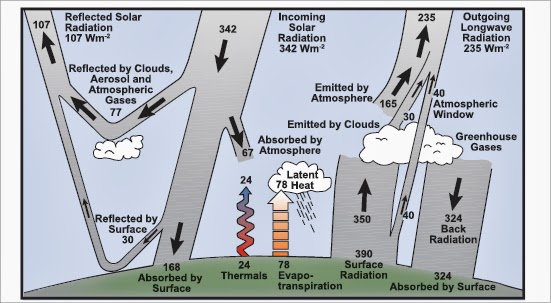
FAQ 1.1, Figure 1. Estimate of the Earth’s annual and global mean energy balance. Over the long term, the amount of incoming solar radiation absorbed by the Earth and atmosphere is balanced by the Earth and atmosphere releasing the same amount of outgoing longwave radiation. About half of the incoming solar radiation is absorbed by the Earth’s surface. This energy is transferred to the atmosphere by warming the air in contact with the surface (thermals), by evapotranspiration and by longwave radiation that is absorbed by clouds and greenhouse gases. The atmosphere in turn radiates longwave energy back to Earth as well as out to space. Source: Kiehl and Trenberth (1997). URL: http://www.ipcc.ch/publications_and_data/ar4/wg1/en/faq-1-1.html
The nature of energy exchange is that for every watt of energy that comes in from the sun (342 Watts per square meter) an equal number of Watts energy (325 + 107 = 342 Watts per square meter) must be radiated back into space. If all that energy came in and went out directly the surface of the earth would average a temperature of -19 degrees Celsius, which is obviously too cold for human (or most other type of) life. What happens is that greenhouse gasses (listed above but especially water vapor and secondarily carbon dioxide) absorb the heat for a while and bounce it back into the atmosphere. This bounced back radiation called logically "Back Radiation" is crucial for making life livable. The heat gets to bounce around for a while longer, raising the temperature of the atmosphere near the surface to an average of 14 or 15 degrees Celsius - a much more hospitable climate. Ultimate all that heat energy does leave and the total amount emitted does equal the amount that comes in from the sun, but there is this time delay, allows the lower atmosphere to reach a warmer temperature. The upper atmosphere where the final heat exchange does occur is -19 degrees Celsius.
Suddenly it all makes sense!
The other thing that really helped me this week was some nice organizing lists that helped me order some information that I already had. The Radiation Balance of the Earth is the equation that looks at all the factors found in that diagram above - how much energy comes in, how much is reflected, how much is absorbed, how much crucial back radiation there is and of course how much is ultimately radiated back to space. While it is always true that the ultimate amount radiated back to space must equal the incoming solar amount, the proportions that are reflected, absorbed by the surface and Back radiation can vary.
There are three fundamental ways to alter the complex equation that is the radiation balance of the earth. First factor, the amount of radiation in coming from the sun can change. This is due to two things: a) changes in the sun itself that affect the sun's energy output and b) changes in the earth's axis tilt and orbit around the sun which affect the time and angle at which sunlight strikes the earth. Second factor is changes in albedo or reflectiveness of the earth - how much of the sun's short wave radiation (light, ultraviolet, etc.) is reflected back before it can warm the earth's surface. Things that change albedo are: the amount of surface covered by ice and snow (highly reflective), the amount of vegetation on the surface (a forest reflects less than a desert), the amount of cloud cover (tops of clouds reflect light back), and the amount of particulates and aerosols in the air - the more aerosols the greater the reflectivity (particulates and aerosols can be naturally occurring from volcanoes, or man-made from smokestacks and car exhausts). The third factor concerns the altering of long wave (heat) radiation patterns, changes that affect the amount of heat immediately radiated into space versus the amount of Back Radiation there is - the amount of heat held and returned to the atmosphere for a while before it is ultimately dissipated into space. The third factor is affected by the chemical composition of the atmosphere, such as changes in water vapor, carbon dioxide, methane, ozone, CFC's and nitrous oxide.
I knew all those things, but that's a nice organizing schemata!
Saturday, July 31, 2010
one small proposal for gettting from here to there
Our earth is undergoing measurable global climate warming that has a significant anthropogenic component, with the primary anthropogenic contribution to warming coming from the steady increase in CO2 emissions from the use of fossil fuels such as oil and coal. Moreover, warming that has already occurred over the past century and warming that is certain to occur in the next century, have had and will have recognizable negative impacts on the health of human beings and human societies. Those impacts include, but are not limited to, rises in sea level and loss of shoreline, changes in plant and animal populations (declines, increases, shifts in range) including changes in disease vectors (such as West Nile Virus and Malaria carrying mosquitoes), increasing drought with its impact on food crops and human water supplies, and increasing extreme precipitation events with concomitant flooding.
Among the scientific community there is debate and need for continuing research on how much warming and how fast future warming will occur, and the regional patterning of impacts, but there is general consensus on the basic facts of warming and its causes and its consequences. Recent polling of the general population in the United States shows that about three quarters of the American population accept the scientific consensus on the reality of global warming and the anthropogenic causes of that warming. However, there is a decided lack of consensus both within the scientific community and the general population on exactly what should be done to address the problems posed now and in the future by global warming.
Just because people agree that a problem exists and that something should be done, has never meant that they will agree on what to do about that problem. This has always been true. There are lots of good sociological and psychological reasons for this lack of agreement. From a psychological perspective immediate, present threats to one's livelihood and material well-being are more salient and real than predicted future threats no matter how real we consider those future threats to be. A parent will always be more concerned about the present day need to keep a roof over their children's heads and food on the table today, than they will be about the availability of housing and food for those children in 20 years.
From a sociological perspective we have organized our economy around the need to maintain very short term current profitability to retain investors, rather than around long term future. The structures, rules and practices of business decision-making and investor decision-making, make it difficult for either business managers or investors to forgo current profits in exchange for long term sustainability.
For a utility company currently generating most of its electricity from coal fired plants shifting to solar or wind generation has many economic drawbacks. If a utility simply purchases "green" power from another electricity producer who is already invested in wind, solar or hydro-power, the primary profit from power production goes to the actual producer not the utility company purchasing the power. To make any profit, they have to raise the cost of that power to the customer, making it more expensive than the coal generated power, and thus less attractive to consumers of electricity. Such a move also introduces greater inefficiencies -- the further electricity is transmitted the greater the loss, so purchases power from a distant provider means that you get less power for your buck as well.
On the other hand, if a utility company decides to themselves begin producing electricity from wind, solar or hydro sources, there is the huge upfront capital investment that must be made. While this may have great long term profit potential (once constructed one never has to pay for sunlight or wind unlike coal), it has tremendous short term costs that affect profitability and investor satisfaction. If a utility attempts to pay for this by raising utility rates up front, there is substantial customer dissatisfaction, and in states (like Kentucky) with strong political incentives to protect coal, little political interest for public utility commissions to support such rate increases. Additionally, the construction of a centralized solar or wind generation plant requires huge acreage, that may not be readily available to a utility company near its customer base.
Finally, another reason that utility companies become nervous about discussions, is that the idea mode of generating electricity from solar energy is a pattern of dispersed, household level or building level generation, where solar panels sufficient to the needs of a particular housing unit or office building are placed on the building itself. This eliminates two problems: first, all the extra land that would be needed for centralized solar generation, and second, the problem of electricity losses due to transmission over distance. However, since currently housing unit and office building solar electricity generation is financed and operated by individual families or businesses it represents a loss of revenue for the utility company, and certainly not something they really want to encourage.
Moreover, from the point of view of the individual, family or business, the cost of constructing small localized solar (and wind) generation is quite large (at least $20,000), and far beyond the reach of the median household. While such household level solar (and wind) electricity generation does pay for itself over twenty to twenty-five years (the vast majority of the costs are in the initial hardware and installation and after that the electricity itself is essentially free), the upfront costs are prohibitive for all but the most affluent and most environmentally committed.
Now, finally to my proposal. I acknowledge up-front, as a person who is uncomfortable with the power of utility companies now, this is not my ideal solution, but it is a means of decreasing the input of CO2 into the atmosphere, to ameliorate future extent of global warming and its impact, while dealing with many of the problems outlined above. My proposal is that electric utility companies currently heavily invested in their own coal-fired generation consider adopting the model used by Bell Telephone in the 1950's. In exchange for a modest installation fee (say a few hundred dollars that could be prorated over a period of time) well within the budgets of middle and working class families with "green values," the utility company would deliver and install solar panels on the consumers home -- but, and here's what I think is a new idea (at least as applied to electricity generation) the utility company would retain ownership of those panels in perpetuity, and charge the consumer a monthly fee for the electricity consumed from those panels.
Here's the details -- the one's that I think would make this idea appealing to both the consumer and to the utility company. The individual solar installations would 1) be large enough to provide for ordinary, peak daylight hours electricity use and 2) would be tied into the grid allowing for both inflow and outflow. The utility company would benefit, because all excess electricity generated would flow into the grid for use by other customers (and unlike the situation where a household customer owns the solar installation, the utility company would own that excess flow outright and not be paying the customer with the installation for it). With each household or business that added solar generation, the electricity generating capacity of the entire grid would be expanded. The capitalization costs would be spread out over time -- no huge up-front investment in generation capacity years before any new power can be generated. Moreover, following current phone company and cable company practices, the utility company could charge a very small (a few dollars) monthly maintenance fee to consumers, to cover costs of periodic maintenance and repair.
The consumer would benefit in two ways: they would have the assurance that in the absence of sunlight they would still have electricity, and conversely, during widespread power outages due to downed transmission lines they would also still have their locally generated power. Indeed, if several households in a neighborhood had contracted with the utility for solar panels, the entire neighborhood circuit might be protected from electricity loss during a widespread outage.
In the beginning only middle income and upper income families that are highly committed to environmental, "green" values would participate. I know I would. I would be very willing to pay a reasonable premium in installation costs just to be assured that while I was sitting at my computer typing away I was using electricity generated by solar power rather than by coal obtained by scalping the mountains around me. Overtime, as people begin to notice, that one of their neighbors still has electricity after a storm has knocked out everyone else, the appeal of solar panels might spread. If the utility made the cost of electricity generated in situ from the solar panels marginally less expensive (say 1/2 cent per KWH) compared to electricity pulled from the grid, this would increase the appeal of participation.
From the utility company's perspective, they are able to gradually expand their generating capacity, using "green" sources, with small, periodic expenditures of capital that can be partially charged to the customer (installation fees), and also recouped by feeding all excess electricity generated into the grid. Customers without the panels who depended solely on the grid would pay the standard rate for their electricity. By dispersing solar generation through out the households served by a utility, there would be a substantial increase in efficiency, as electricity would be consumed closer to where it was generated, reducing the losses to long distance transmission. Most of all this idea allows utility companies to make the transition to renewable electricity generation gradual and incremental, and thus less painful and more acceptable.
So there is my idea -- somebody tell me what's wrong with it!
Saturday, July 24, 2010
weather is not climate, but....

The Weather Channel's website has a number of nifty new features. One of which provides you with lots of information about how your current month (and previous month) stack up against historical weather patterns. I've captured the screen shots for my zip code 41825, for June 2010 and July 2010.  Notice that for both June and July the "highest temperature recorded so far" is higher than the historical record for that month -- so we broke the all time temperature records for both June and July in Eastern Kentucky. Notice also that the total rain fall amounts for both June and July are well below the average. June's precitipation total was 1.05" below the average. Of course July isn't over yet, but let's hope we don't get 3.65" of rain in one week. While the July total rain is more than three and a half inches below normal, eastern Kentucky did get one whale of a gully-washer, to the great dismay and anguish of hundreds of folks in Pike county.
While it is important to remember that weather is not the same as climate, and unusually hot days occur periodically, as do droughts and floods, overall warming of the climate as is currently occurring on planet earth, does give rise to more frequent extreme heat, more common droughts, and paradoxically more frequent intense rain events like that seen in Pike County this month.
Monday, July 5, 2010
Where are the global warming deniers?
The first thing to remember is, as any competent climate scientist will tell you, weather and climate are NOT the same thing. A snow storm or a heat wave are weather. Climate is a decades long pattern made up of millions of weather events. Climate has predictable patterns, that can be modeled by computer simulations with some accuracy over decades. Weather is far more variable, and accurately predictable only several days at a time.
There is, of course, a connection between climate and weather. Climate is the long term accretion of weather events. More rainy days, with more inches of rain create wetter climates. And wetter climates create more rainy days with more inches of rain. However, even in the rain forest (climate) it is dry sometimes (weather), and even in the desert (climate) it rains sometimes (weather).
During the midst of the heavy snow storms, the deniers of the reality of global warming, happily confusing weather and climate, were loudly crying "where are the global warming supporters?" "Where is Al Gore?" Ignoring (of course) that models of global warming actually predict an increase in extreme precipitation events including extreme snow storms. But now the worm or at least the weather has turned. See the CNN article: Blistering heat expected in Northeast - CNN.com and a heat waves of historic proportions are gripping the U.S. this summer.
Some very hot summer days are not proof of global warming any more than some very snowy winter days are disproof. But as the climate warms, the frequency of both very hot summer days and very heavy precipitation events (winter and summer) tend to increase. The likelihood of each new summer producing new records for heat increases as climate warms.
So my question is, where are you, global warming deniers? How do you account for this? Do you only recognize the difference between climate and weather when it is convenient for you to do so?
Friday, June 18, 2010
ice watch

Since the summer of 2007, when Arctic ice extent hit an all time measured low, I have developed an ice watch fascination that generally sets in when the summer heat does in June.
The National Snow and Ice Data Center Sea Ice Index, provides a daily snapshot of the extent of ice in the Arctic Ocean. Both in map form and in a graph. The gray line is the average ice extent from 1979 to 2000, the green dotted line was the ice extent in 2007, the lowest ever measured. Right now, in June 2010 (blue line), the extent of Arctic ice is well below that of the recorded minimum from 2007 -- less ice, more open water, less reflected sunlight, more absorbed heat. This does not automatically mean that we will set a new record in 2010 for the smallest ice extent, because Arctic winds and storms can retard ice melting (and increase it); but a new record low ice extent does seem to be possible this year.
Subscribe to:
Posts (Atom)